
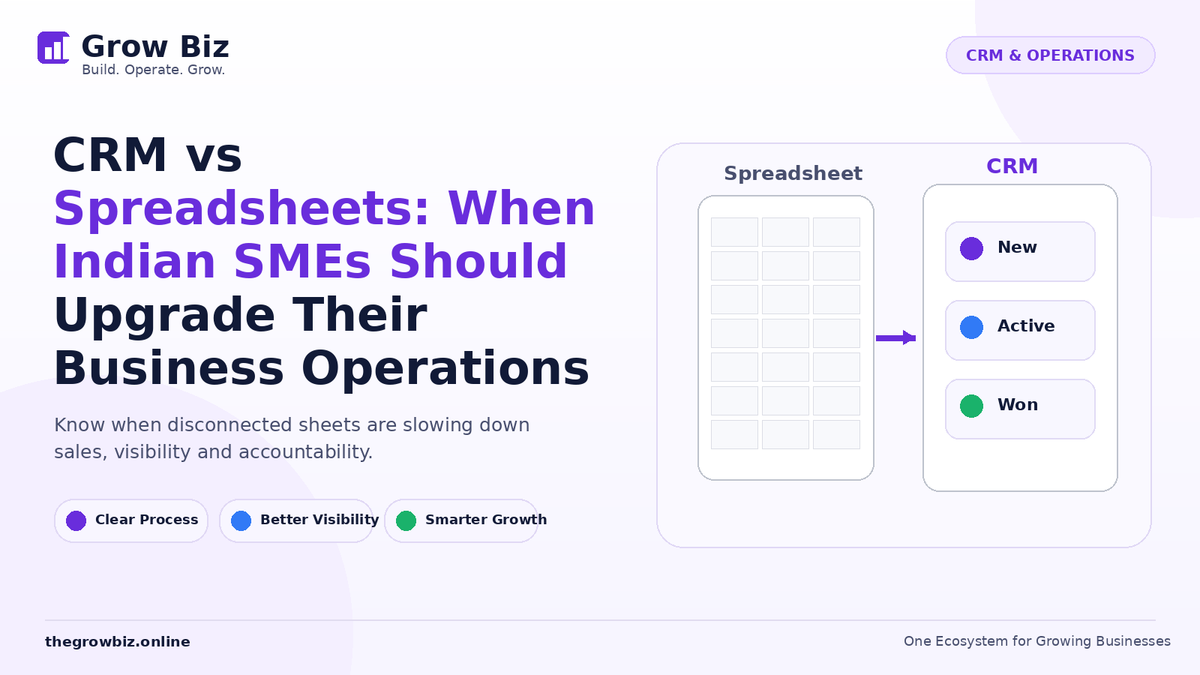
Growing businesses rarely struggle because they lack tools. More often, the problem is that information is scattered across spreadsheets, WhatsApp chats, email threads, notebooks and separate apps. A lead may begin in a marketing campaign, move into a salesperson's phone, become a client in a spreadsheet and then reach operations with important context missing. The result is duplicated work, slower follow-up and limited management visibility.
A connected business operating system solves a different problem from simply adding more software. It creates one structured flow for leads, customers, tasks, projects, documents, reporting and day-to-day accountability. For an SME, that can make growth easier to manage without making the organisation unnecessarily complex.
What is a connected business operating system?
A connected business operating system is a central workspace that brings core business workflows together. Instead of maintaining separate records for sales, clients, projects and operational activity, teams work from shared information and defined processes. The objective is not to eliminate every specialist tool. It is to create a reliable operational layer so important business data does not disappear between departments.
For example, a qualified lead should be able to move from initial enquiry to sales follow-up, proposal, client onboarding and delivery without the team repeatedly re-entering the same information. Management should also be able to see what is happening without asking every employee for a manual update.
Why spreadsheets and WhatsApp become difficult as an SME grows
Spreadsheets and messaging apps are useful, flexible and familiar. They can work well when a company is small. The difficulty appears when multiple people begin editing different files, maintaining their own versions and using private conversations as the main record of business activity.
1. There is no single source of truth
Two employees may hold different information about the same lead or client. One spreadsheet may show a follow-up pending while a WhatsApp conversation shows that the customer already replied. When the business depends on people remembering where the latest information lives, execution becomes fragile.
2. Follow-ups depend too heavily on memory
A growing pipeline can contain dozens or hundreds of conversations. Without structured ownership, stages, next actions and dates, valuable opportunities can become inactive simply because nobody followed up at the right time.
3. Management reporting becomes manual
Founders and managers often spend time asking for updates, combining spreadsheets and checking messages before they can understand performance. A connected system should make routine visibility easier by keeping activity tied to the relevant lead, client, project or employee workflow.
4. Handoffs create information loss
The transition from marketing to sales, sales to onboarding, or onboarding to operations is a common point of failure. If each team maintains separate records, the receiving team may not know what was promised, what the customer expects or what action is due next.
What should an SME connect first?
Trying to digitise everything at once usually creates unnecessary disruption. A practical approach is to start with the workflows that most directly affect revenue and customer experience.
Lead and CRM management
Every meaningful enquiry should have an owner, source, status, next action and follow-up date. This gives the sales team a consistent process and gives management a clearer view of the pipeline.
Client onboarding
Once an opportunity becomes a client, the commercial context should move into onboarding without being recreated from scratch. Contact details, scope, responsible team members, documents and key expectations should be organised in one place.
Projects, tasks and operations
Delivery work needs clear ownership and deadlines. Connecting tasks to the relevant client or project helps teams understand why the work exists and reduces the chance of operational activity becoming detached from customer commitments.
Reporting and management visibility
A useful operating system should help leaders answer simple questions quickly: What opportunities need attention? Which work is overdue? Which clients are active? Where are handoffs slowing down? The value comes from making decisions from current operational information rather than periodic manual reports.
How to move from disconnected tools without disrupting the team
Start by mapping the current workflow before choosing what to automate. Identify where information enters the business, who owns each stage, what data is essential and where delays usually occur. Then standardise the process before adding automation.
Next, migrate only the information the team actually needs. Old duplicate spreadsheets and outdated records can make a new system confusing from day one. Establish simple rules for naming, ownership, stages and required fields so everyone works consistently.
Finally, introduce automation selectively. Reminders, status changes, reporting and repetitive handoffs are good candidates, but important customer decisions should still have clear human ownership. Technology should make accountability easier, not hide it.
Where Grow Biz OS fits
Grow Biz OS is being developed as one operating system for growing businesses, with the goal of connecting business operations in a single workspace. For SMEs that are outgrowing scattered spreadsheets and conversations, the important question is not whether every tool should be replaced. It is whether the business has a dependable system for managing information, ownership and execution.
The broader Grow Biz ecosystem combines consulting, technology, education and business solutions, allowing operational improvement to be approached as a business process rather than only a software installation.
Frequently asked questions
When should a business move beyond spreadsheets?
Consider a more structured system when duplicate data, missed follow-ups, unclear ownership, manual reporting or cross-team handoff problems are becoming frequent. The trigger is operational complexity, not a particular company size.
Does a business operating system replace every app?
Not necessarily. Specialist tools may still be useful. The goal is to create a connected operational foundation and reduce unnecessary fragmentation.
Should SMEs automate everything?
No. Automate repetitive, rules-based work first. Keep human review for customer relationships, exceptions, approvals and decisions where context matters.
Build a more manageable growth system
If your team is managing leads, clients and operations across disconnected files and chats, the first step is to map the workflow and identify where information is being lost. Explore Grow Biz OS or visit Grow Biz to understand how a more connected operating model can support your next stage of growth.